
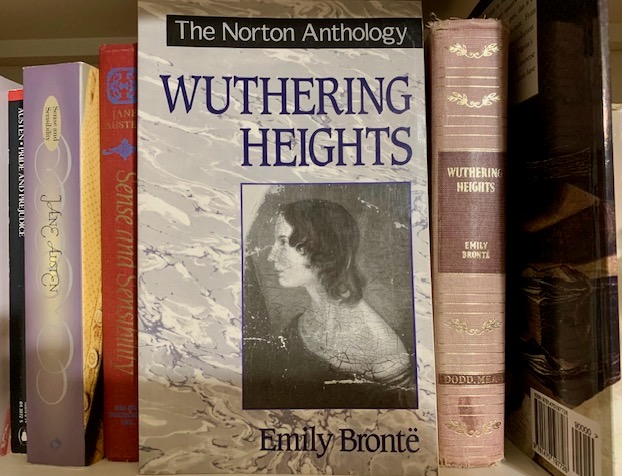
What’s always hooked readers and kept them coming back to this dark story is the unrestrained passion and wild undercurrents of brutality in the fierce love between Heathcliff and Catherine, the protagonists of the novel—a fierceness that reflects the harsh natural world of the rugged west Yorkshire moors on which the story takes place. The book’s title, “Wuthering Heights,” is the name of the ancient house where much of the action takes place. The term “Wuthering” is an old Yorkshire word describing the strong winds that blow across the moors. Bronte herself defines it in the novel as “descriptive of the atmospheric tumult to which its station is exposed, in stormy weather.” It comes in the novel to figuratively describe the violent passions that govern the book’s chief characters.
Cathy’s rejection of her soul-mate Heathcliff and marriage to her neighbor, the aristocratic Edgar Linton of Thrushcross Grange, is the event that sets in motion the tragedy of the novel, which catalogues Heathcliff’s long and inexorable revenge on Linton and all his family—including Linton’s sister, whom he marries and emotionally abuses, and his daughter, even though she is also his beloved Catherine’s.
This novel appears on an astounding 90 “Great Books” lists. The Observer included it on its “100 Greatest Novels of All Time” list, Penguin Classics readers ranked it as their 71st favorite novel, and it was named the 43rd favorite novel of librarians by Bookman.com. It was ranked as #22 on Entertainment Weekly’s Top 100 Novels, #14 on The Telegraph’s “100 Novels Everyone Should Read,” #12 on the BBC’s “Big Read,” and #7 on the BBC’s list of the “100 Greatest British Novels,” #6 on The Daily Telegraph’s “Top 50 Books,” and #3 on the Guardian’s list of the “50 Best-Loved Novels Written by a Woman.” But Emily Bronte’s novel is not simply popular in the U.K. and America. It was #83 on the German “Big Read,” #50 among French readers of Le Monde. It was 40th on the Bulgarian “Big Read,” 39th on the Hungarian “Big Read,” 25th on the Gazette’s “Top 100 Books Chosen by Canadians,” 13th on the Australian “Big Read,” and 7th in the world on the OCLC’s “Complete 500,” which is based on the number of libraries with this book on their shelves. If all that isn’t enough to get you to read this novel if you haven’t already done so, maybe the rest of this post will help.
Compared with her sister Charlotte’s masterpiece Jane Eyre, Emily Bronte’s novel met with a fair amount of confusion and distaste upon its initial publication in 1847. A reviewer for Graham’s Lady Magazine asserted “How a human being could have attempted such a book as the present without committing suicide before he had finished a dozen chapters, is a mystery. It is a compound of vulgar depravity and unnatural horrors.” And a number of other reviewers found similar faults with its treatment of mental and physical cruelty, its disregard for Victorian morality, and the fierce savagery of the passion displayed. But reviewers found it impossible to ignore the raw power and originality of the novel. Take the married Catherine’s explosive confessions to Nelly Dean concerning her undying love for Heathcliff:
Nelly, I am Heathcliff –he’s always, always in my mind—not as a pleasure, any more then I am always a pleasure to myself –but, as my own being.
or
He shall never know I love him: and that, not because he’s handsome, but because he’s more myself than I am. Whatever our souls are made out of, his and mine are the same.
Based on the power of these unwonted revelations, the book has since accumulated its own fair share of ardent admirers, and is currently perhaps even more acclaimed than its sister novel (see what I did there?).
Wuthering Heights also informatively reflects social tensions in Europe at the time of its composition, tensions which no reader thinks about today but class tensions that sparked the publication of Marx and Engels’ Communist Manifesto in late 1847 and which were to erupt the following year in revolutionary activity in France, Italy, Austria, the German states, Denmark, the Netherlands, Poland, and elsewhere. Heathcliff, the foundling, possibly gypsy, orphan adopted by the Earnshaw family of Wuthering Heights, is bullied by the wealthy family’s heir, Hindley, and thwarted in his ambitions toward the Earnshaws’ daughter Catherine by the patrician Linton, but ultimately triumphs and essentially overthrows his oppressors—though the regime he establishes following his insurgency becomes a reign of terror.
But more significantly for modern readers, it seems to me—the aspect of the novel that marks it as a cut above other novels in its Gothic genre—is what Bronte does with the narration. There are two first-person narrators of the story, each of whom has his or her own attitude toward the events and characters, and neither of whom the reader can trust as a totally objective and wholly reliable narrator.
We first see things from the perspective of Mr. Lockwood, who has just rented Thrushcross Grange, as he visits his landlord Heathcliff at Wuthering Heights, where he finds the landlord, his servant, and the strange young man Hareton and young woman Cathy Linton, and finds them all to be rude and surly. Forced by a snowstorm to stay in Heathcliff’s house overnight, Lockwood finds the diary of the room’s one-time occupant, Catherine Earnshaw, and has a nightmare in which the ghost of Catherine scratches at his window. Making his way back to Thrushcross Grange through the snow, Lockwood falls ill, and during his recovery is told the story of the Earnshaws and the Lintons by his housekeeper Ellen Dean.
Ellen, or “Nelly,” has been a servant in the Earnshaw family for thirty years, and her narration, which makes up most of the novel, begins with Heathcliff’s sudden adoption into the family by the father, who found the homeless boy living on the streets in London and raised him as his own. She speaks of Heathcliff and Catherine’s close ties, of how Cathy’s brother Hindley reduced Heathcliff’s role to that of a servant upon inheriting Wuthering Heights, and of how Catherine decided to marry Edgar, confiding to Nelly her love of Heathcliff but her reluctance to marry him because of his low social status. Nelly goes on to tell how Heathcliff fled the country, returning three years later as a wealthy man, and how he married Linton’s sister Isabella as a form of revenge on both Linton and Catherine herself. Ellen goes on to tell of Catherine’s death and Heathcliff’s despair, and of the sorrows of the next generation of the family, largely caused by Heathcliff’s poisoned psyche. In language of enormous power, Heathcliff cries out upon Catherine’s death
Where is she? Not there—not in heaven—not perished—where? Oh! you said you cared nothing for my sufferings! And I pray one prayer—I repeat it till my tongue stiffens—Catherine Earnshaw, may you not rest as long as I am living; you said I killed you—haunt me, then! The murdered do haunt their murderers, I believe. I know that ghosts have wandered on earth. Be with me always—take any form—drive me mad! only do not leave me in this abyss, where I cannot find you! Oh, God! it is unutterable! I cannot live without my life! I cannot live without my soul!
When Nelly’s tale concludes, having brought Lockwood, and the reader, up to the present day, Lockwood goes on to tell how he moved away from the moors, but returned to Wuthering Heights eight months later to find a number of things altered. I won’t go into detail so as not to include too many spoilers here. But in the end, it’s fair to say that Nelly is hardly an objective observer of events, and presents a more sympathetic attitude toward Heathcliff and the two youngsters, Hareton Earnshaw and Catherine Linton, her “two babies,” than other characters might have. A close reader can also discern events where she seems to be an innocent bystander but which, if she had acted differently, would have often proven less disastrous. Lockwood himself is a bit of a snob, seems never to question any of Nelly’s conclusions, and at one point seems mildly interested in pursuing young Catherine as a potential wife. Thus he may not be so trustworthy a narrator either. Ultimately readers are left to puzzle things out for themselves.
But challenging the reader in that way makes Wuthering Heights a book one must keep thinking about. The powerful love story has made Brone’s novel a favorite source for film and television adaptations, and readers coming to the novel after seeing the classic 1939 William Wyler film that starred Lawrence Olivier as Heathcliff, or even Timothy Dalton’s less powerful portrayal in the first color film of the book in 1970, are inevitably surprised when they read the novel and find that Catherine dies at almost precisely the halfway point of the novel, and that the story must work itself out through Heathcliff’s revenge on the survivors of the Linton family and on his oppressor Hinton Earnshaw’s heir. Of course, you will probably never be able to read the novel without imagining Olivier as Heathcliff. Even so, you don’t know the story if you haven’t read the book.
No less a critic than Virginia Woolf wrote this about Wuthering Heights in 1916:
Wuthering Heights is a more difficult book to understand than Jane Eyre, because Emily was a greater poet than Charlotte. When Charlotte wrote she said with eloquence and splendour and passion ‘I love’, ‘I hate’, ‘I suffer’. Her experience, though more intense, is on a level with our own. But there is no ‘I’ in Wuthering Heights. There are no governesses. There are no employers. There is love, but it is not the love of men and women. Emily was inspired by some more general conception. The impulse which urged her to create was not her own suffering or her own injuries. She looked out upon a world cleft into gigantic disorder and felt within her the power to unite it in a book.
Read Wuthering Heights, or go back and read it again, and see if you can feel what Woolf was feeling. I guarantee you’ll feel something strange, even chilling, but a terrible kind of beauty as well.