Tolkien, whose day job was as a professor of Anglo-Saxon at Oxford University, dabbled in world-creation in his spare time from as early as 1917—beginning with his creation of two different elvish languages, Quenya and Sindarin, and the alphabets that go with them. He invented Middle Earth and made up the stories first in order to create a context for the languages he’d created. Sometime around 1936, while grading exams, he invented a creature called a hobbit who lived in a hole in the ground, and he wrote a children’s story about one such creature, Bilbo Baggins, who had an adventure. His subsequent novel The Hobbit became a popular success, and his publisher, Allen & Unwin, encouraged him to write a sequel. Like his character Treebeard the Ent, Tolkien was not keen on doing anything hastily, and having started out his “new Hobbit” in the same vein as his earlier book, he altered his conception to compose a sweeping epic adventure that expanded after some twelve years of writing into some 1500 pages in six books plus Appendices.
The success of this monster of a book was as much a surprise to him and it was to his publisher: Allen & Unwin were on the fence about publishing Lord of the Rings—it was long and it was not thought of as mainstream fiction, and it would be very expensive to print in post-war Britain where there were shortages of things like paper. Raynor Unwin read the manuscript of Lord of the Rings and told his father, who ran the company, that they would probably lose a thousand pounds in publishing it, but that it was a work of genius. His father said, “Well, for a work of genius I’ll spend a thousand pounds.” But to hedge their bets, the publisher gave Tolkien no advance payment, and told him they would pay no royalties on the book until they had made back their investment. The incentive they gave him was that once they made back their initial costs, they would pay him half of all the profits. But they assumed they’d never have to pay him anything. To everyone’s surprise, Lord of the Rings ended up selling something like 200,000,000 copies over the years. So Tolkien’s contract ended up being the most lucrative publishing contract ever signed.
Aside from the popularity, the acclaim garnered by Lord of the Rings was unprecedented for a work of fantasy. On the “Greatest Books of All Time” web site, it is ranked as number 16 worldwide, in a list that contains all languages and all books, not just novels. And according to that web site, it appears on 105 great books lists It appeared on the Time magazine list of the greatest novels since 1923, and on the Observer’s list of the 100 greatest world novels. It was 49th on the Penguin list of “must read classics” as chosen by their readers, 26th on the BBC list of “Greatest British Novels.” More impressive, it was the 5th most loved book in the PBS “Great American Read,” 3rd on the Library Journal’s “Books of the Century” list, and 2nd on the New York Times Book Review’s reader survey naming the “Best Book of the Past 125 Years.” And it came in as number one on Waterstone’s “Books of the Century” list, number one on NPR’s list of the “Top 100 Science-Fiction/Fantasy Books,” number one on the Australian “Big Read,” number one on the German “Big Read,” and number one on the original (2003) BBC “Big Read.” It’s been honored on lists compiled in France, Germany, Hungary, Bulgaria Turkey, Korea, and on and on. In 1999, Amazon.com named Lord of the Rings the “Best Book of the Millennium.”
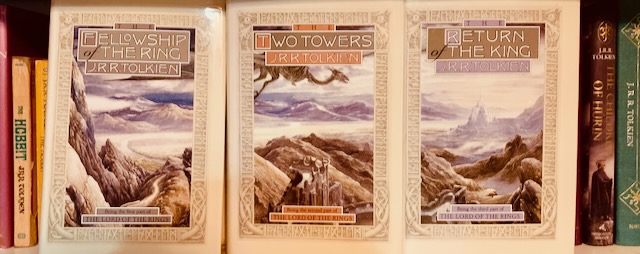
It seems futile for me to try to briefly summarize the complex plot of this three-volume novel, and the story is so well known to the tens of millions who have read Lord of the Rings and the hundreds of millions who have seen the faithful Peter Jackson film trilogy that it hardly seems necessary. But in case you are the one human who has done neither, or in case you need a quick refresher, let me give it a try: In The Fellowship of the Ring (volume I),The wizard Gandalf comes to realize that the magic ring found by the hobbit Bilbo Baggins (in The Hobbit) is the “One Ring to rule them all” created by the Dark Lord Sauron in the previous age of Middle Earth, and convinces Bilbo to give the ring to his nephew Frodo and leave Hobbiton for the Elves’ kingdom of Rivendell. Years later, Gandalf returns to warn Frodo that Sauron has sent his spies, nine black riders, to search for the Ring. Frodo and his friends Sam, Merry and Pippin set off to leave the hobbits’ homeland, the Shire, and, meeting the Ranger Aragorn on the way, are guided to Rivendell. In a council convened by Rivendell’s king Elrond, it is decided that the Ring, which corrupts anyone who wears it, cannot be used as a weapon against Sauron but must be destroyed in Mount Doom, in Mordor (Sauron’s kingdom) where it was forged. Frodo volunteers to carry the Ring to Mordor, supported by his three hobbit friends, Gandalf, Aragorn, the elf Legolas, the dwarf Gimli, and Boromir, son of the steward of Gondor, the human kingdom that borders Mordor. On the journey, Gandalf falls while battling a monstrous Balrog, the fellowship is aided by Galadriel, queen of the elven territory of Lorien, but Boromir, maddened by the lure of the Ring’s power, attacks Frodo and tries to take the Ring from him. He is killed by a band of Orcs, the Dark Lord’s army, who kidnap Merry and Pippin. Frodo and Sam go off together to enter Mordor.
As the story advances through the second volume (The Two Towers), Aragorn, Legolas and Gimli chase the Orcs who had taken Merry and Pippin into Rohan, a kingdom traditionally allied with Gondor. Aragorn is revealed to be the heir to the throne of Gondor. Saruman, head of Gandalf’s council of wizards, treacherously betrays the alliance and joins Sauron. Frodo and Sam, making their way toward Mordor, are being followed by Gollum, the creature who had owned the One Ring for centuries and who wants to get it back. Using the Ring as an incentive, Frodo convinces Gollum to lead them into Mordor without being seen. As the climax of the story approaches (in Return of the King, the third volume), a great battle is fought before the gates of Gondor, as Frodo and Sam struggle mightily to reach Mount Doom. I won’t, of course, reveal the final outcome of the novel, but I’m pretty sure most of you already know it.
But why did it sell so well? One reason is Tolkien’s use of what Carl Jung calls archetypal motifs—motifs that are part of the human psyche that appear in mythologies the world over, such as the quest, the father figure (Gandalf), the Shadow involving a descent into an underworld (Mordor): any work of literature that contains universal elements like these (e.g. Star Wars) will appeal to readers. But more specifically, the first readers of Lord of the Rings saw it as an allegory of the Second World War, during which much of the manuscript was composed: the importance of defeating Nazism (Hitler=Sauron) which had threatened to swallow up England, and could only be defeated through great sacrifice. But when the work really took off in popularity was in the later 1960s, when young people at the time saw it as applicable to things they were concerned about. The One Ring suggested nuclear weapons—those symbols of the absolute power that corrupts absolutely. Treebeard and the Ents, who decisively resist the destruction of the natural environment by the traitor Saruman, were early spokespersons for environmentalism. And there was the draw of escapism from a world that seemed to be going all wrong, into a world where good and evil were more clearly delineated.
But Tolkien himself insisted that The Lord of the Rings was not allegorical—he disliked the didactic and blatant Christian allegory apparent in his friend C.S. Lewis’s Narnia books. The story was, however, “applicable,” he said, to the experiences of contemporary readers. And succeeding generations have always found something in their time to which the story seemed applicable. Plus, of course, there are the hobbits. The unassuming, everyday little people, to whom everyone can relate, are the biggest reason for Tolkien’s success—and they are why The Silmarillion and later posthumous publications have never sold as well as The Hobbit and Lord of the Rings.
Other serious literary scholars have criticized the work as escapist, the characters as underdeveloped, the language as overwrought, and the theme as cliché. As I’ve said elsewhere, these critics miss the point that Tolkien hasn’t written a novel in the conventional sense, but has written a “fairy story,” the aims of which he clarified in his significant 1939 lecture “On Fairy Stories.” Fairy stories, he argued, are not simply for children. Historically they come from the great “cauldron of story” from which all mythic elements derive. As “secondary creators,” the authors of fairy stories emulate the primary creator, God Himself, and readers must accept them with an imaginative “secondary belief.” As for “escape,” Tolkien notes that there are two kinds of escape: one involves a desertion of responsibility; the other is like the escape of a refugee from a tyrannical regime. Fairy stories are the latter: we escape the ugliness of the contemporary human condition and see the world in a new way. Finally, and most importantly, the fairy story contains a sudden reversal and what Tolkien calls a eucatastrophe (a mirror image of the peripetia and catastrophe of tragedy). This involves a sudden happy turn of the plot that reflects what the Christian Tolkien regarded as the transcendent truth of miraculous Grace. For him, this was at least as realistic as the disastrous ending of a tragedy.
As for the charge that the themes of the novel are cliché, that is true only in the sense that the themes of all thee most ambitious literary texts, from The Iliad to Paradise Lost to Don Quixote to Goethe’s Faust are “cliché” or, to put it another way, are universal. Tolkien’s are most certainly so, and are expressed in memorable language, even if it sometimes seems “overwrought.” Consider some of Gandalf’s early warnings to Frodo as he sets out on his quest. When Frodo laments that it was a pity Bilbo did not kill Gollum when he had the chance, Gandalf asserts it was pity that stayedBilbo’s hand.
“Many that live deserve death,” Gandalf says. “And some that die deserve life. Can you give it to them? Then do not be too eager to deal out death in judgement. For even the very wise cannot see all ends. I have not much hope that Gollum can be cured before he dies, but there is a chance of it. And he is bound up with the fate of the Ring. My heart tells me that he has some part to play yet, for good or ill, before the end;”
His notion proves correct, but the point of the comment is universal: that human beings have no right to play God, and cannot see how their actions might affect the future adversely. Much of the novel underscores the cliché that power corrupts, and absolute power corrupts absolutely, but Tolkien lays most stress on the aspect of that truism that involves the self-delusion that an uncorruptible individual might use absolute power only for good. Boromir, for instance, succumbs to this vain desire, while Faramir is able to resist it. Most significant is the response of the elf-queen Galadriel, already a being of awesome power and open to who Frodo willingly offers the ring:
“And now at last it comes. You will give me the Ring freely! In place of the Dark Lord you will set up a Queen. And I shall not be dark, but beautiful and terrible as the Morning and the Night! Fair as the Sea and the Sun and the Snow upon the Mountain! Dreadful as the Storm and the Lightning! Stronger than the foundations of the earth. All shall love me and despair!”
She lifted up her hand and from the ring that she wore there issued a great light that illuminated her alone and left all else dark. She stood before Frodo seeming now tall beyond measurement, and beautiful beyond enduring, terrible and worshipful. Then she let her hand fall, and the light faded, and suddenly she laughed again, and lo! she was shrunken; a slender Elf woman, clad in simple white, whose gentle voice was soft and sad.
“I pass the test”, she said. “I will diminish, and go into the West and remain Galadriel.”
Galadriel is tempted almost beyond enduring, but is wise and self-aware enough to realize that in taking the ring she will lose herself, and chooses for herself the fate of all her race—to return to the undying lands and leave Middle Earth to the Fourth Lage, the age of men.
Sam, whom Tolkien called “the true hero” of the book, is, like the rest of the hobbits, a reminder that great deeds are most often performed by everyday mortals who are thrown somehow into situations in which their acts may have great significance. He meditates on this in Mordor as he conceives of Frodo and himself involved in what may at some time be remembered as a great story:
“The brave things in the old tales and songs, Mr. Frodo, adventures, as I used to call them. I used to think that they were things the wonderful folk of the stories went out and looked for, because they wanted them, because they were exciting and life was a bit dull, a kind of a sport, as you might say. But that’s not the way of it with the tales that really mattered, or the ones that stay in the mind. Folk seem to have been just landed in them, usually their paths were laid that way, as you put it. But I expect they had lots of chances, like us, of turning back, only they didn’t. … I wonder what sort of a tale we’ve fallen into?”
Here is simple, everyday English—hardly overwrought language. Of course there’s an irony in this self-reflexive aspect of the story but it underscores a universal theme that Tolkien’s story brings home. And it’s what makes Lord of the Ringsso much more accessible than other adventurous tales, including his own Silmarillion. It’s the simple humanity of the hobbits that make them the relatable heroes they are. And it also allows the hobbit Sam to gain a perspective no one else in the trilogy seems to achieve.
“There, peeping among the cloud-wrack above a dark tor high up in the mountains, Sam saw a white star twinkle for a while. The beauty of it smote his heart, as he looked up out of the forsaken land, and hope returned to him. For like a shaft, clear and cold, the thought pierced him that in the end the Shadow was only a small and passing thing: there was a light and high beauty for ever beyond its reach. His song in the Tower had been defiance rather than hope; for then he was thinking of himself. Now, for a moment, his own fate, and even his master’s, ceased to trouble him.”
Viewed from the point of view of eternity, from the celestial sphere, the events in which Sam is involved are only a small footnote in the universal text, the shadow of Mordor only a passing thing, and, in Tolkien’s Christian view, “there’s a divinity that shapes our ends, rough-hew them how we will.”
That, of course, is the conclusion of Shakespeare’s Hamlet, a universal truth that I suppose you might call cliché. But like Hamlet, Tolkien’s novel underscores the fact that human beings may fool themselves into believing they are in control when in fact they are quite mistaken. The memorable scene in Return of the King that most exemplifies this theme is full of Shakespearean allusions. When Rohan’s king Theoden falls on the field of battle and is about to be killed by the chief ring-wraith, or Nazgul, the warrior Dernhelm (Theoden’s niece Eowyn in disguise) beseeches him “Leave the dead in peace!” To which the Black Rider responds “Come not between the Nazgûl and his prey!” It is a clear echo of King Lear’s response to Kent when the old man is about to disinherit his faithful daughter: “Come not between the dragon and his wrath!” Eowyn responds thus:
A sword rang as it was drawn. “Do what you will; but I will hinder it, if I may.”
“Hinder me? Thou fool. No living man may hinder me!”
Then Merry heard of all sounds in that hour the strangest. It seemed that Dernhelm laughed, and the clear voice was like the ring of steel. “But no living man am I!”
The Nazgul is destroyed by the woman Eowyn and the hobbit Merry—not by any living man. It’s clearly Macbeth, who knows that “none of woman born” can harm him, but is destroyed by one who was “from his mother’s womb untimely ripped.” In this passage, the language may seem overwrought, but that’s mainly because it’s reflecting Shakespeare. So perhaps it may be excused.
The enormous popularity of Lord of the Rings made fantasy, as Tolkien conceived it, a part of the mainstream literary world, and particularly after Lord of the Rings, no one could ever write fantasy again without taking Tolkien into account. Some, like J.K. Rowling, do it fairly obviously and unapologetically. Some, like Philip Pullman (in the His Dark Materials trilogy) use elements like the quest, the medieval-like setting, the helpful animals, but make a clear departure from some aspect of Tolkien’s work, in Pullman’s case a departure from Tolkien’s theistic world view reflected in his use of eucatastrophe. Some, like Terry Pratchett in his Discworld series, borrow a lot of motifs from Tolkien but take a comic twist, making fun of Tolkien’s detailed maps, for instance, by giving readers a blank map of his imaginary discworld. And another popular contemporary fantasy writer, George R.R. Martin, emulates Tolkien in numerous ways—he’s created a medieval-like setting, his world is as complete and self-contained as Tolkien’s (though perhaps shallower in its history), he uses dragons and a very human dwarf, huge battles and supernatural evil. But his worldview deliberately undercuts Tolkien’s optimistic, heroic, and spiritual presentation, and gives us a mock-medieval world that is dreary and dark. Everybody doesn’t write as Tolkien did, but everybody writes in response to Tolkien.