Back in the old days, when as a twenty-something TA I would teach the occasional “Intro to Lit” classes as a break from those endless rounds of freshman comp, I would always include Waiting for Godot and tell my students it was the most important play of the post-war era (that’s World War II for you youngsters out there). I was vindicated in 1998 when a poll conducted by Britain’s Royal National Theatre named Beckett’s two-act “Tragicomedy” “the most significant English-language play of the 20th century.”
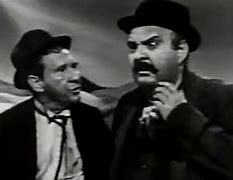
As an undergraduate, I had written a 20,000 word senior Honors Thesis on “The Absurd in Literature” in which I spent a good number of those words on Beckett, who at the time had quite recently won the Nobel Prize for Literature. I found the tenets of absurdity in literature to be 1) that the universe is meaningless; 2) that if the universe has any meaning, it cannot be known; and 3) that if the universe had any meaning that can be known, it cannot be expressed in language. And I found Waiting for Godot to be the quintessence of those criteria. Yet for all my love of the play, in all the time since those undergraduate days, I had seen only one fairly mediocre college production of the play, supplemented by a videotape of a somewhat abbreviated made-for-television version starring Zero Mostel and Burgess Meredith that had aired in 1961 and was directed by Alan Schneider, who had been the director of the first American production of the play. So you will understand my enthusiasm when I learned that the stars of the “Bill and Ted” films were planning a new production of the play on Broadway this fall, at a time when I might actually be able to see it.
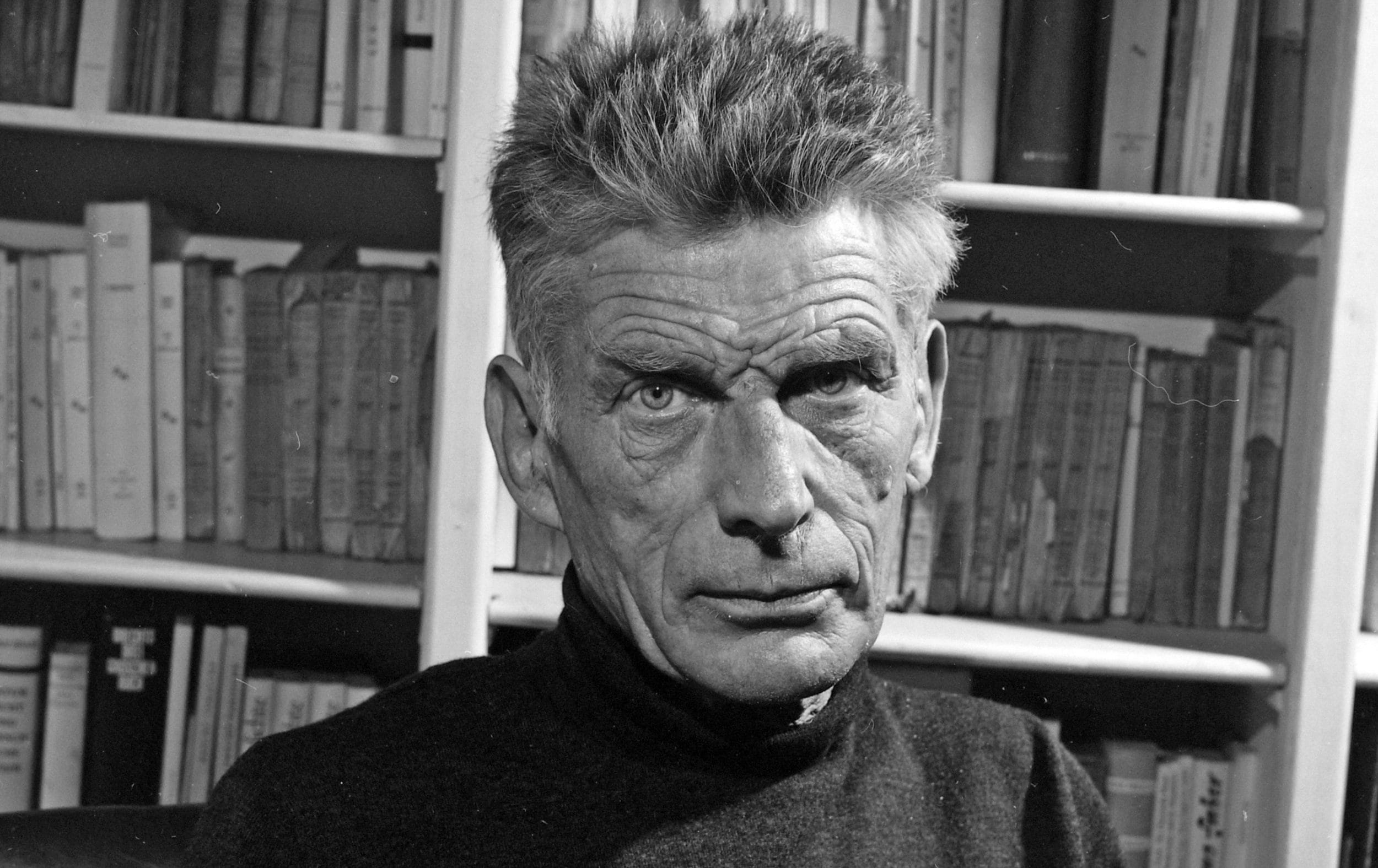
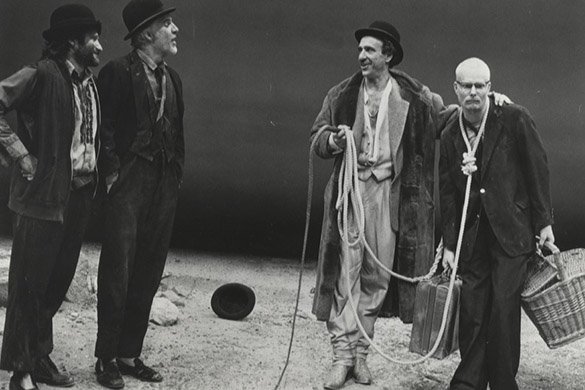
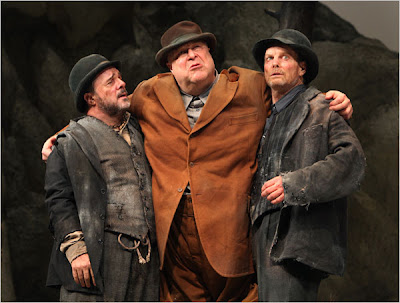
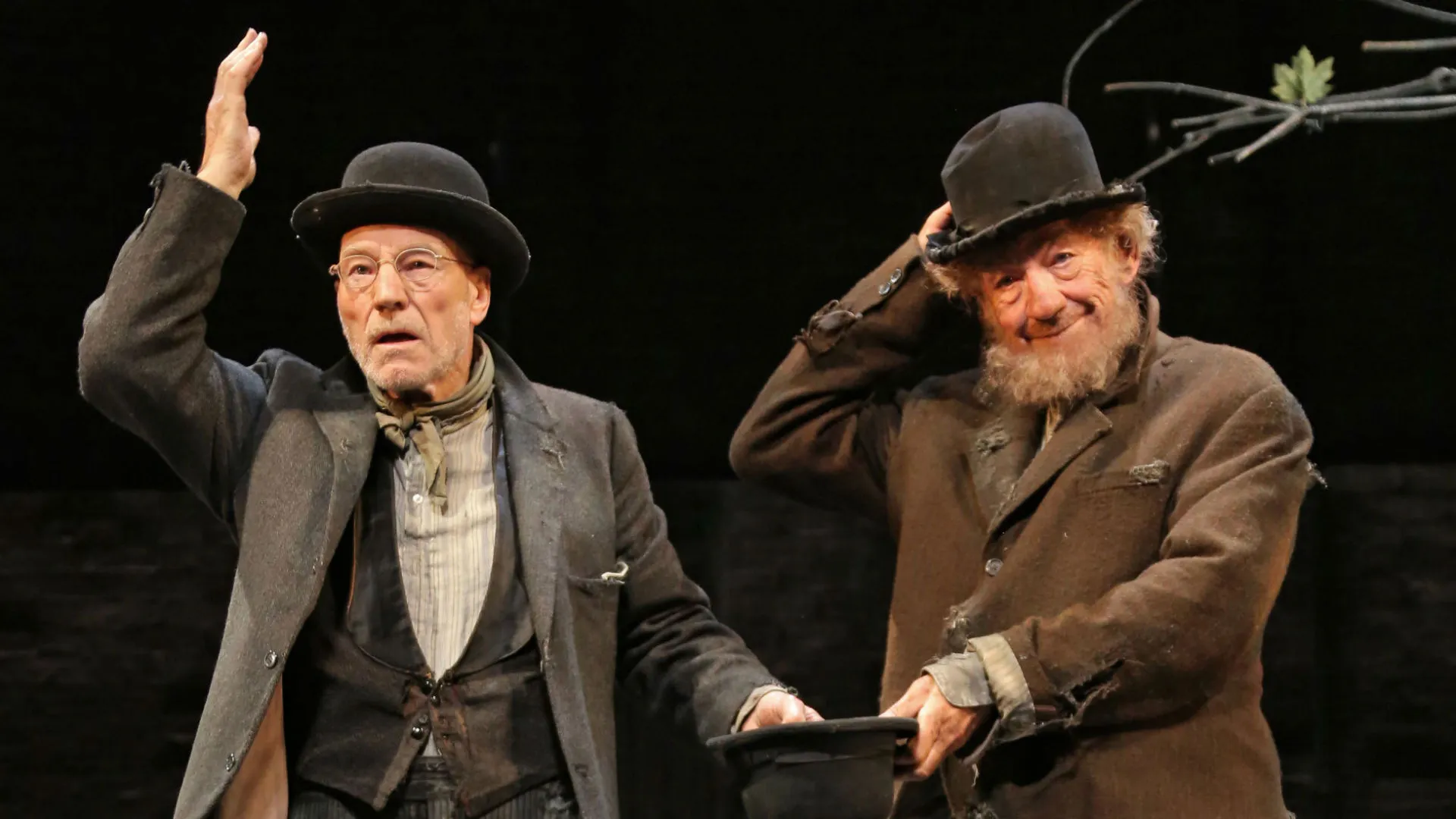
Beckett liked to write his plays in French first, and then do his own English translations. His En attendant Godot premiered at the Théâtre de Babylone in Paris, in January 1953. The English version directed by Peter Hall was first staged in the Arts Theatre in London in August 1955. It first appeared on Broadway directed by Herbert Berghof at the John Golden Theatre in April of 1956, and featured E.G. Marshall as Vladimir and everyone’s favorite cowardly lion, Bert Lahr, as Estragon. Since then there have been several significant New York revivals of the play. Most famous perhaps was the 1988 revival at Lincoln Center directed by Mike Nichols and starring Robin Williams as Estrogon and Steve Martin as Vladimir (F. Murray Abraham played Pozzo). That production had a limited run of seven weeks. In 2009 Nathan Lane played Estragon to Bill Irwin’s Vladimir and John Goodman’s Pozzo in a Broadway revival that was nominated for three Tony Awards. In November 2013, Sean Mathias directed another revival at the Cort Theatre on Broadway that featured Ian McKellen as Estragon and Patrick Stewart as Vladimir (yes, Gandalf meets Jean-Luc Picard in the great post-modern void). It ran for four months.
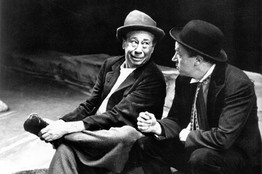
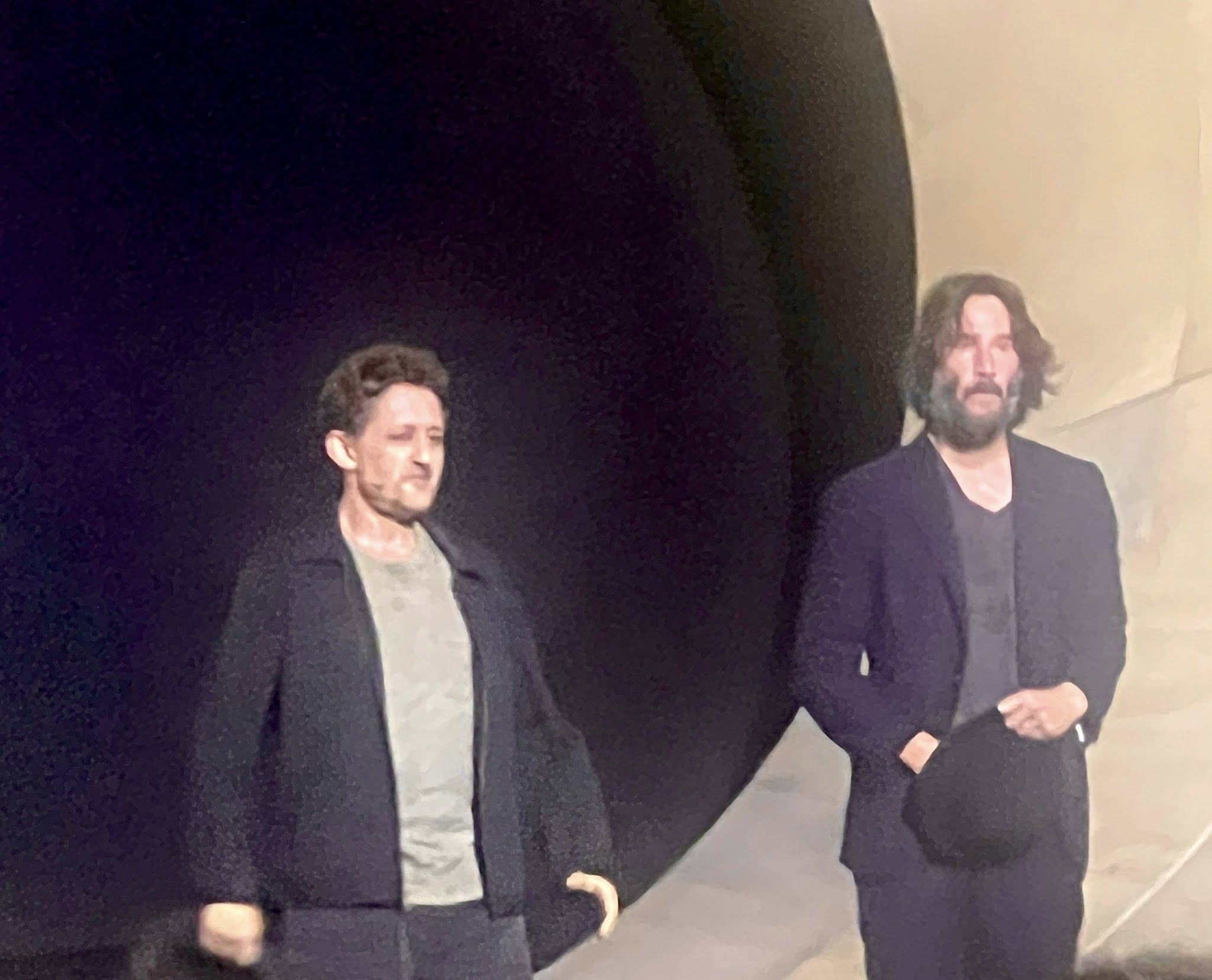
Any of these revivals would have been exciting to see, and each I’m sure had its own virtues, though one wonders whether the big name stars ever tried to make the part their own rather than lose themselves in Beckett’s words. Because in Godot, it’s really Beckett who is the true star of the show. And though I never had a chance to get to New York to see any of those three significant revivals, it turned out I actually would be able to find the time, if my wife and I could find the money, to get to New York and see the play in its newest iteration: Featuring Keanu Reeves and Alex Winter (and directed by Jamie Lloyd, the award-winning director of recent hit revivals of Sunset Boulevard, A Doll’s House and Betrayal) we saw a preview production two days before its official opening on September 28. If you know anything about current Broadway ticket prices, you know that you might have to sell your firstborn child to score a ticket that may be going for as high as $500 for a popular show.
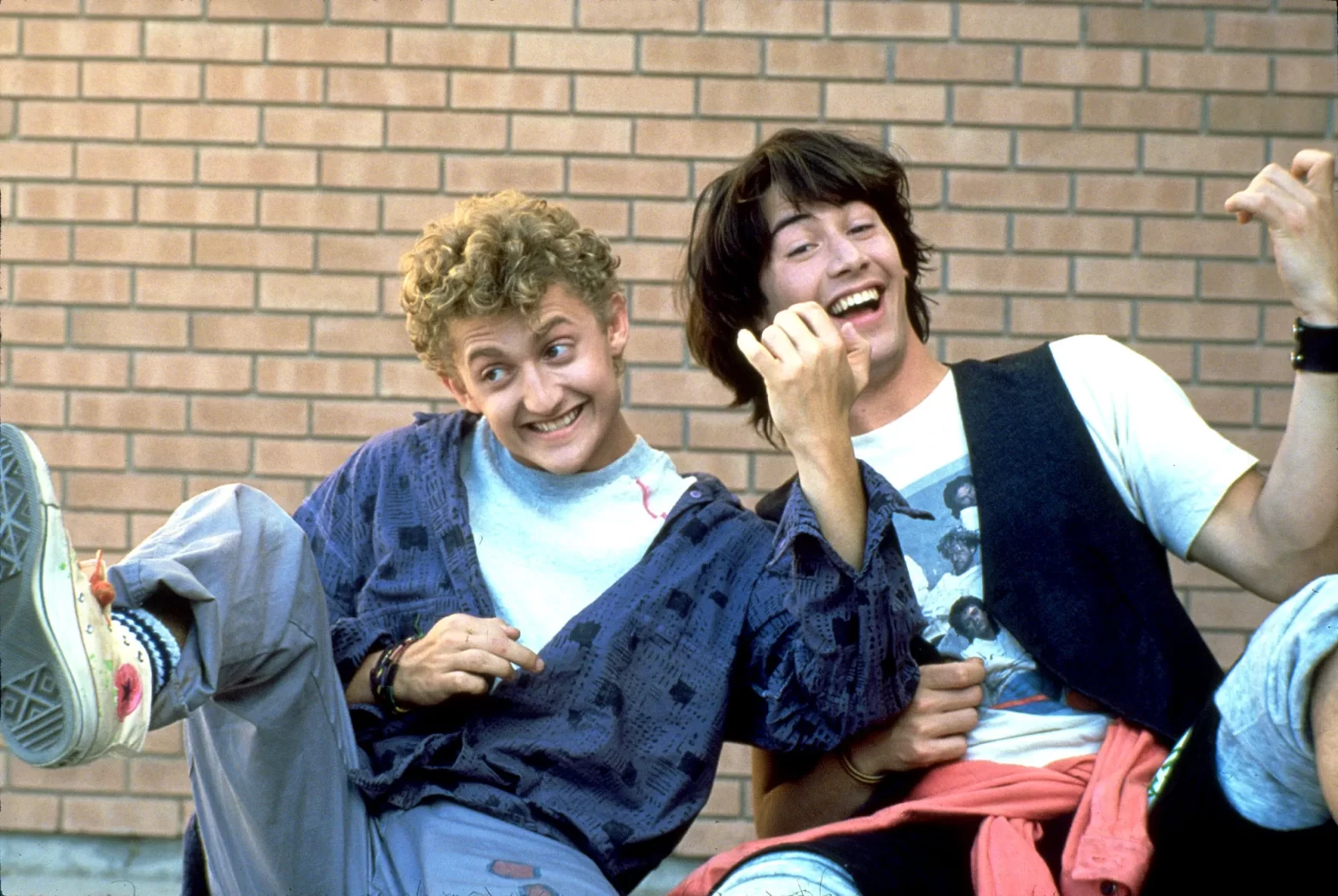
I was intrigued from the beginning at the thought of Bill and Ted as Beckett’s two tramps. Bill and Ted’s Excellent Adventure came out in 1989, the year Beckett died. One wondered whether the Nobel laureate might perhaps be rolling over in his grave. But Beckett famously based Vladimir and Estragon at least in part on Laurel and Hardy, and some of their antics in the play—their vaudeville-inspired business with the rapid-fire exchange of three bowler hats, for instance—are inspired by the kind of clownish comedy the current duo brought to “Bill and Ted” films that confronted deep questions of time and human existence (“Dust…wind…Dude”), and even came face to face with Death itself, all with a naïve optimism and an absurd confidence. This is, after all, Theatre of the Absurd, and what could be more absurd than Bill and Ted facing existential crises?
Certainly the night we were there, the Hudson Theater on Broadway was filled with Bill and Ted fans, not necessarily with Beckett aficionados. At one point in the play’s second act, when Estragon (Reeves) tells Vladimir (Winter) that they will be “back to back, like in the old days,” the two stand back-to-back and, playing directly to the audience, do a quick air guitar riff, just like Bill and Ted. And the audience of Bill and Ted lovers went wild. It’s only for a second or two, and it’s a way of acknowledging what their audience came to see. In part the viewers saw what they expected to: two longtime friends who after nearly forty years displayed an unfeigned affection for one another, a way of exchanging banter that registered as completely natural, and a very believable vibe of “we’re in this together.” In a way it was like watching an old Hope-Crosby Road picture. But this is precisely what is appropriate for the characters of Vladimir and Estragon: They have been together forever and can recall decades of shared memories, and though they often speak of finally parting—they even speak of possibly hanging themselves and escaping the long dark misery and monotony of life—at the end of each day they face the futility of Godot’s failure to show up at his appointed time with the certainty that they do at least exist, and the unreasonable, even absurd, hope that perhaps tomorrow Godot will come.
Reeves as Estragon (or “Gogo” as Vladimir familiarly calls him) is cautious, vulnerable, constantly crossing arms or legs in a protective manner, often feeling defeated or wanting to leave. One refrain that Beckett includes in the play six times is this exchange:
Estragon: Let’s go.
Vladimir: We can’t.
Estragon: Why not?
Vladimir: We’re waiting for Godot.
Estragon: Ah!
It’s Vladimir (or “Didi”) that is concerned with keeping the appointment, with remaining optimistic, with searching for meaning. Winter as Didi projects that kind of confidence that is in fact bravado. As a more seasoned stage actor (this is Reeves’ first appearance on Broadway), Winter brings that experience to bear as he projects the rational confidence that is his frail shield against the void particularly movingly, and absurdly, in the final scene when a young boy comes on to tell him Godot will not show up, but will surely do so tomorrow.
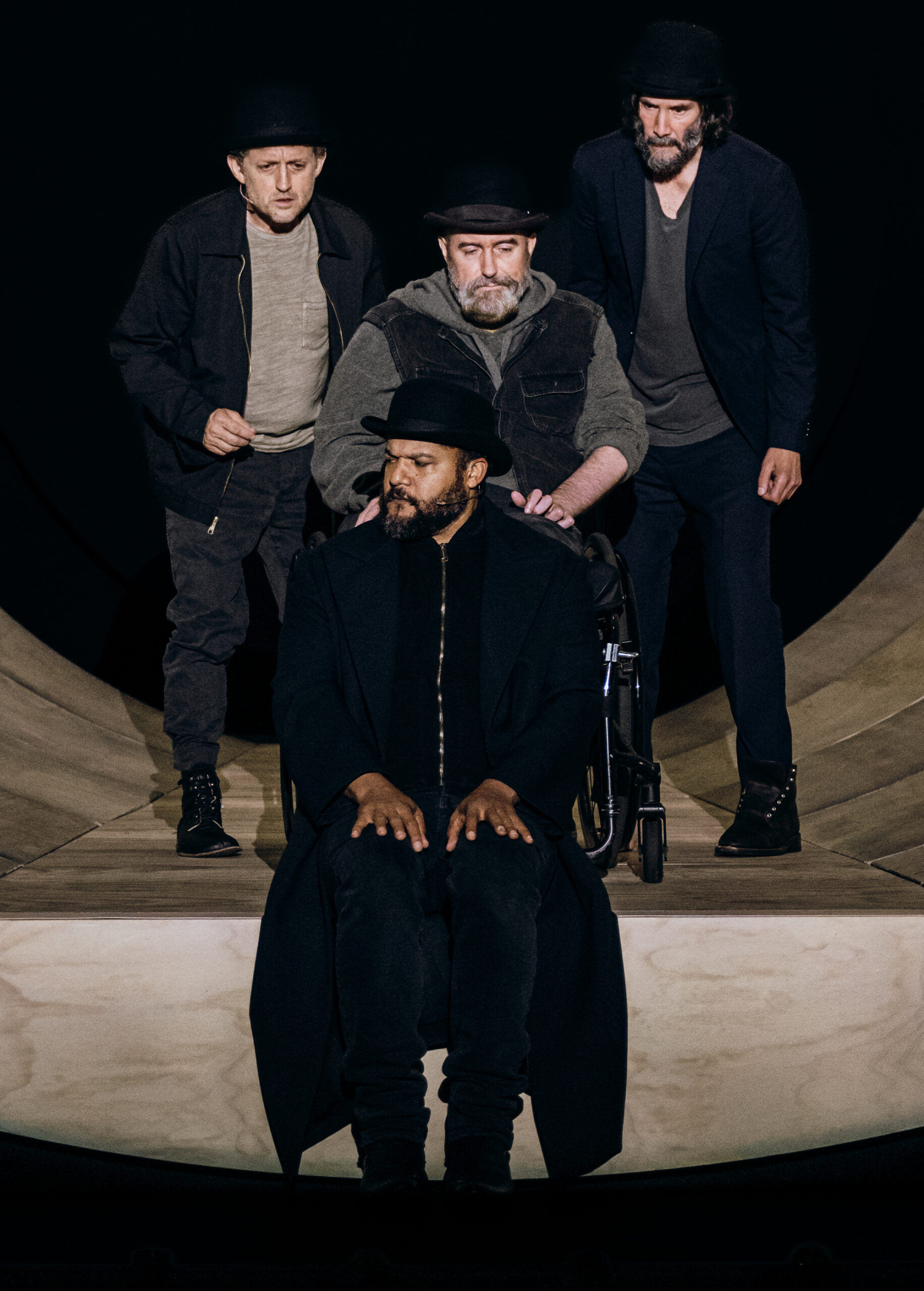
Two seasoned stage actors who shine in the supporting roles of Pozzo and Lucky are Brandon J. Dirden (Pozzo), veteran of several Broadway shows, and Michael Patrick Thornton (Lucky) who appeared in Lloyd’s production of A Doll’s House. As Pozzo, Dirden dominates the stage in Act I as a loud, narcissistic bully who can charm with the accent of a southern gentleman, a façade that thinly disguises his fascist soul as he treats his servant Lucky like a slave. In Act II, Pozzo has gone blind and returns much subdued, bemoaning the meaninglessness of existence in his final line: “They give birth astride of a grave, the light gleams an instant, then it’s night once more.” As for Thornton, he nearly steals the show when he is commanded to “dance” by his intimidating master, and he responds by making his derby hat dance in a Chaplin-like sequence from his wheelchair.
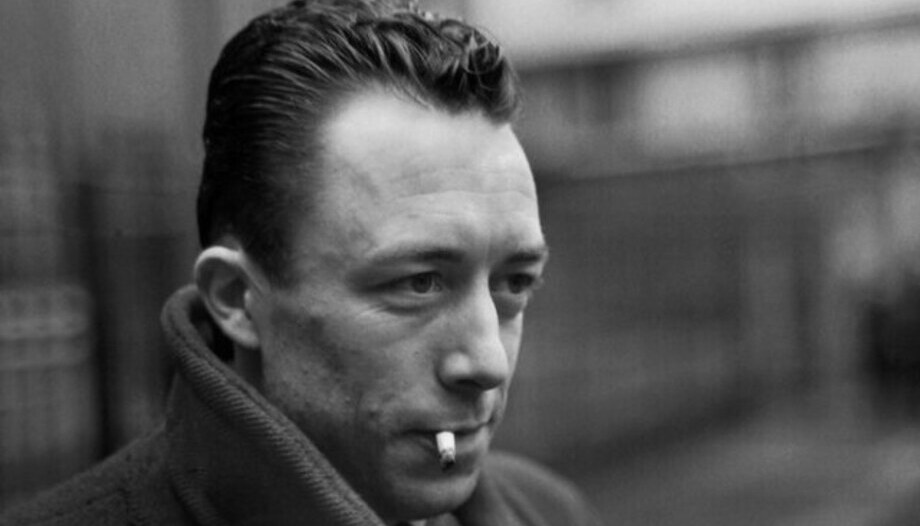
It was Albert Camus who first defined “the absurd” in his essay “The Myth of Sisyphus.” The universe, he said, may in fact have some transcendent meaning, but as a human being he had no way of telling what that meaning was. And unlike his contemporary existentialist writers Sartre and de Beauvoir, who argued that human beings must themselves give the world meaning, must give “essence” to their own “existence” by committing to some responsible choice, Camus, in contrast, asserted that human beings have a yearning for meaning—but the universe is impossible to reduce to what he calls “a rational and reasonable principle.” What is absurd is the human attempt to find meaning. Camus finds Sisyphus to be the perfect illustration of the absurd hero: We build up theories to explain the world, but they all crash down upon us, like Sisyphus’s boulder when he reaches the hilltop, and must be built again.
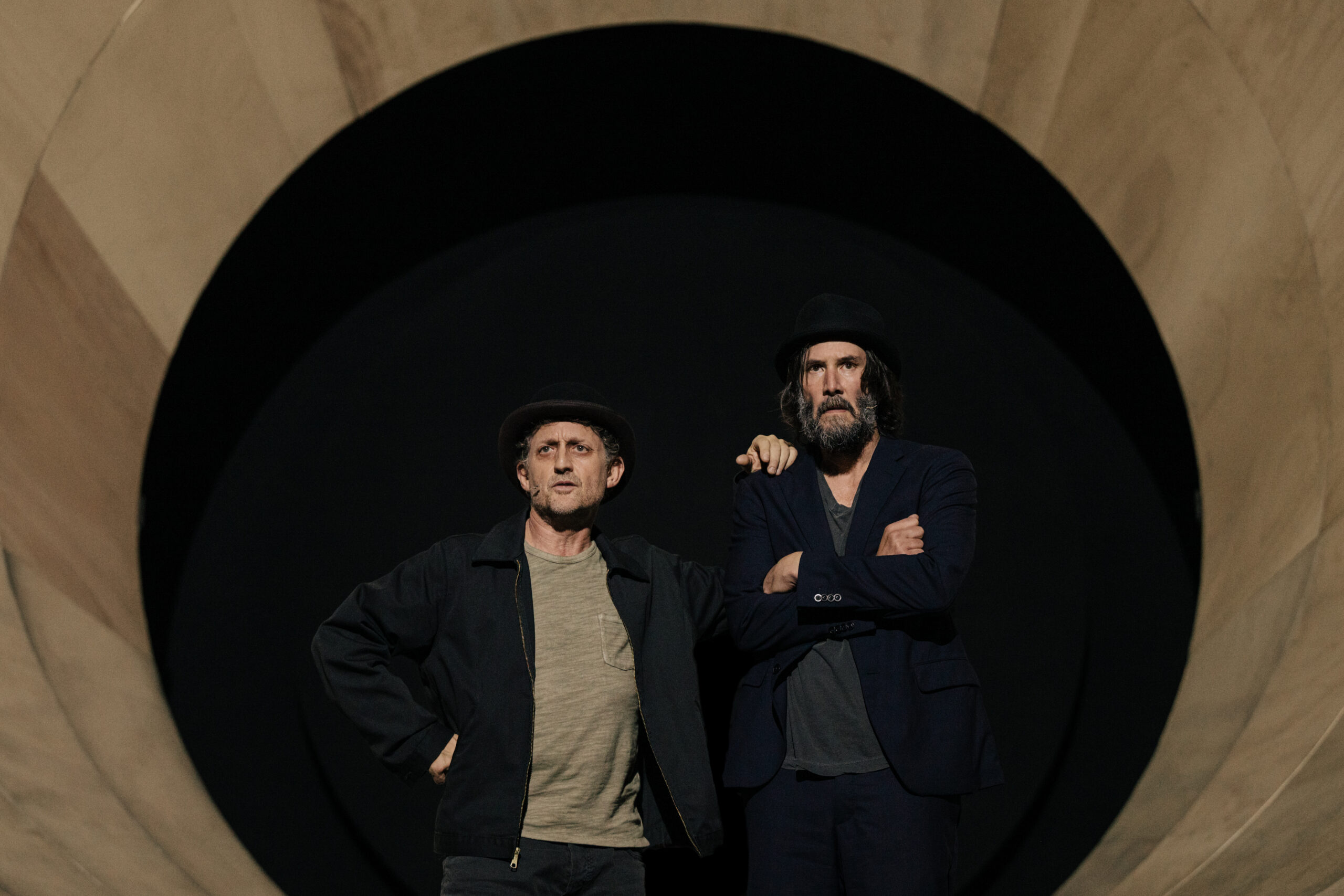
Lloyd’s set designer Soutra Gilmour has come up with a perfect visual metaphor to illustrate this absurdity: Instead of the set Beckett’s stage directions for the opening scene describe (“A country road. A tree, Evening”), this production opens with a huge spiral structure in which almost all the action occurs. Instead of the country road, this structure recedes like a long storm sewer into the distance. It gave me the feeling that the void, like a great unfathomable abyss, might come to sweep all away at any moment. But the structure served another purpose: At times Gogo would try to run or climb the side of the structure, only to slide back down again, like Camus’s Sisyphus with his boulder.
The spiral set does mean that the tree, so important in Beckett’s setting, must be imagined to be off stage. However, since the tramps discuss hanging themselves from it, no production has ever really had a large enough tree onstage to make that suggestion feasible. We can imagine any size tree offstage. But there are other props that are essential to the action of the play that Lloyd has chosen to dispense with. There are turnips, carrots, and radishes that Didi supposedly has in his pockets. There’s a pipe to be smoked. Lucky is supposed to be carrying a picnic basket and luggage. Pozzo is supposed to have a rope that circles Lucky’s neck like a leash, and a whip that he uses to beat his slave. All of these are to be imagined and are mimed—which fits the clown-like personae of Didi and Gogo, but causes some confusion: Lucky is supposed to have an infected sore on his neck which is even alluded to in the dialog in this production, but since the rope around his neck has been dispensed with we in the audience are just confused as to where that sore came from.
The lack of rope or whip does away with much of the violence in the play. The one violent act that remains comes in Act I when Lucky kicks Gogo viciously in the shins. But this too is essentially mimed: It occurs far back in the spiral and at least from where I was sitting, it was directly behind Pozzo and could not actually be seen. Beckett was quite clear about the play’s violence. The meaningless world as we experience it is full of violence. Since such violence is essentially purposeless, it is a chief feature of the absurd. Lloyd, known for his deliberately minimalist productions, seems to misapply that quality in this instance. Godot is already as minimalist as any play in the canon. Making it more so doesn’t reduce it to its essentials—it robs it of its meaning.

This production has received mixed reviews since its September 28 opening. As for me, I found nothing to fault it on except perhaps its being overly minimalist in its use of props. That and their pronouncing the Great Personified Blankness’ name GOD-oh rather than God-OH, as most people do (though there is evidence it was GOD-oh for Becket himself). Reeves and Winter acquitted themselves well in their very demanding parts (after all, they talk through the entire play—Beckett’s way of using language to fill the void). They keep speaking as they keep acting even in the face of universal disappointment, like the narrator of Beckett’s most radical post-modern novel, The Unnamable, whose refrain
I can’t go on.
You must go on.
I’ll go on.
ends the novel.
If Winter and Reeves can draw in Bill and Ted fans who may not have been familiar with Beckett, all the better. Their experience of Waiting for Godot will be entertaining, true to the material, and perhaps even life-altering, for Beckett can do that. My wife had never read or seen the play but was thoroughly taken by it after this introduction.
Like Sartre and Camus, Beckett joined the French resistance during the German occupation and was decorated for his service. In a post-war world, after a conflagration that killed 45 million people, including six million Jews, Roma, and homosexuals in a sweeping genocide—and which gave rise to a Cold War world where mutually assured destruction loomed after human beings had actually found a convenient means of ending all life on the planet earth, perhaps the only sane response was this vivid representation of the absurd.
Today, in our post-Truth society, where every day serves up a new outrage asserting that black is white and up is down, that quackery is science and empathy is un-Christian, could Godot be any more relevant? We may be disappointed every night when Godot fails to show up and bring meaning and order into our lives, but we also expect to wake up in the morning in the hope that maybe tomorrow things will make sense. There’s no point in saying we can’t go on. We must go on. We’ll go on. Godot will surely come tomorrow.