
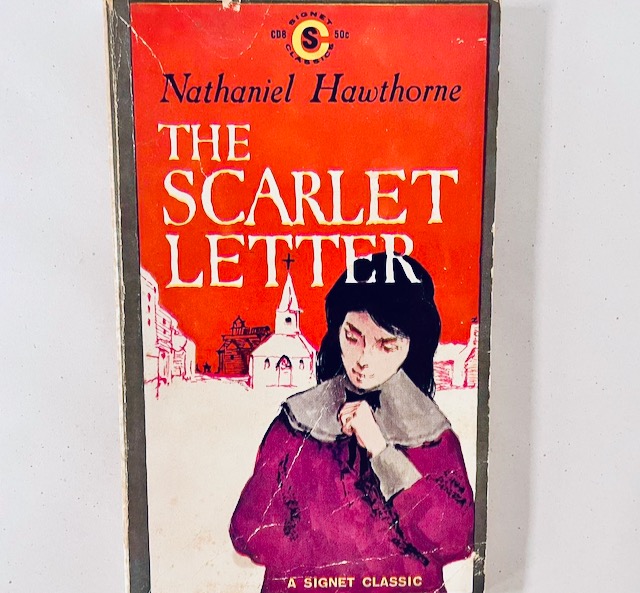
The Scarlet Letter has been a staple of high school English classes since the late nineteenth century. It was the sixth most frequently taught book in the last decades of the twentieth century, and even though in the twenty-first century the traditional literary canon has been largely replaced by more contemporary works by writers of varied ethnicities and genders in high school curricula, The Scarlet Letter is still one of the three most taught novels in American high schools. I have to admit, when my son was reading The Scarlet Letter in tenth grade (and complaining about it), I reread the book and thought, “Wow, this book’s style and diction are really not ideal—maybe not even appropriate—for students at this grade level.” It would be like trying to teach, say, Henry James The Ambassadors or Virginia Woolf’s To The Lighthouse at that level. I think in teaching it then you may be doing a disservice to Hawthorne and to tenth-grade students. But then I remember reading the book myself as a high school sophomore, and I don’t recall being frustrated with it at all, or thinking those same things as a fifteen-year-old. But then, I did read a lot of “classics” at the time. The following abbreviated paragraph from the novel’s twelfth chapter might illustrate the difficulties Hawthorne’s style raises for young readers:
But, before Mr. Dimmesdale had done speaking, a light gleamed far and wide over all the muffled sky. It was doubtless caused by one of those meteors, which the night-watcher may so often observe burning out to waste, in the vacant regions of the atmosphere. So powerful was its radiance, that it thoroughly illuminated the dense medium of cloud betwixt the sky and earth. …all were visible, but with a singularity of aspect that seemed to give another moral interpretation to the things of this world than they had ever borne before. And there stood the minister, with his hand over his heart; and Hester Prynne, with the embroidered letter glimmering on her bosom; and little Pearl, herself a symbol, and the connecting link between those two. They stood in the noon of that strange and solemn splendor, as if it were the light that is to reveal all secrets, and the daybreak that shall unite all who belong to one another.
Now The Scarlet Letter may be one of the first symbolic novels written in America, and Hawthorne’s symbolism is fairly obvious: the light is a symbol of the coming judgment when all sins will be brought to light. Pearl, “herself a symbol,” is a manifestation of Hester’s passion and her sin. This is easy enough for fifteen-year-olds, but look at the nouns Hawthorne uses: radiance, medium, singularity, aspect, interpretation, splendor—words that tend toward the abstract, mental categories that don’t conjure up any sense impressions for the reader. Look at the adjectives: the sky is “muffled”; the radiance is “powerful”; the splendor is “strange and solemn.” None of these adds concreteness to the readers’ impressions. Of the sentences quoted, five are complex while the fifth has an unusual construction with three elaborate predicates. This is a style far from the simple or compound sentences and objective Hemingwayesque prose more typical of modern novels.
The point is that Hawthorne’s novel may not be every high school sophomore’s cup of tea, but for those who do want to read it, it can be an illuminating look at early American history, at Puritan New England as a source for much of contemporary evangelical Christianity and for centuries of repressive patriarchy. But maybe not so ironically, dating back to just two years after its publication, the novel has been the target of moral crusaders who have wanted to ban the book on the grounds of immorality. Even in recent decades the book has been challenged and banned in various school districts, most famously in 1977 when a group of Michigan parents claimed the book was “pornographic and obscene”—presumably because its protagonist has a child as a result of an affair, though of course, anyone who has read the book knows that it never depicts the affair or anything leading up to it. Apparently these parents thought it immoral simply because it discusses an affair. Some object to the fact that Hester Prynne, the adulteress/protagonist, is treated sympathetically. And shockingly but not really surprisingly, a large number of the book’s challengers object to the fact that Hawthorne presents Hester’s vengeful husband in a negative light. Apparently they believe that the poor guy has every right to sadistically avenge the stealing of his “property.”
As many will remember (often with aversion), The Scarlet Letter begins with a long essay called “The Custom House,” purported to be an introduction to the story. Essentially the essay is a quasi-autobiographical satirical essay in which Hawthorne, who was dismissed from his position at the Salem Custom House when the Whig Zachary Taylor took over the presidency from Democrat James K. Polk, takes a few satirical swipes at his former co-workers as well as the people who replaced him. More importantly, he uses the opportunity to reject his Puritan ancestry, as well as contemporary Puritan attitudes. He also allies himself with Hester Prynne when he introduces the completely fictional discovery of her embroidered “A” in the Custom House, along with a manuscript that explains its history: He places it on his own chest and says he experienced “a feeling…as of burning heat.” Hawthorne the narrator sees himself as something like Hester, both of them being isolated from Puritan society, she because of her adultery, he because of his profession as author or artist. Finally, he takes the opportunity to explain why his novel is subtitled “A Romance,” as opposed to a novel. A novel, he says, must be faithful to the probable, to ordinary realistic events. In a romance, on the other hand, a writer is free to utilize his imagination, the ahistorical, even the supernatural, in presenting not a specific realistic truth but the truth of the human condition, or the human heart.
The novel proper opens with the young mother, Hester Prynne, enduring the public disgrace that is her due in seventeenth century Puritan New England for committing adultery and giving birth to Pearl, her illegitimate baby girl. She is sentenced to wear a scarlet “A” on her clothing at all times as a reminder to her and everyone else of her sin.
Hester had believed her husband was dead, since he had left Boston and has wife some time before and never returned. But in the course of the novel, Roger Chillingworth, her estranged husband, returns but conceals his identity from all but Hester. He visits Hester in her jail cell as a physician, and having learned of her offense, he tries to force Hester to name the child’s father, but she refuses. Chillingworth then becomes obsessed with learning the father’s identity. Suspecting it to be the young minister Arthur Dimmesdale—a man who has publicly been urging Hester to name her partner in sin—Chillingworth begins to visit Dimmesdale regularly in his role as physician, for the minister has grown ill as a result of the guilt that is eating away at him. And the physician devotes himself to psychologically tormenting Dimmesdale without revealing his guilt publicly. Meanwhile Hester moves into a small cottage at the edge of town and ekes out a living through her excellent needlework, while regularly performing charitable acts for the poor of the community.
I won’t reveal the details of how the story works itself out, just in case you haven’t read the book and intend to. Suffice it to say that Hawthorne’s universe is one in which a transcendent moral law does exist, and his characters are not exempt from the consequences of their actions—but redemption is possible for those who sincerely seek it.
But Hawthorne’s genius is in his psychological portraits of the three main characters: Chillingworth, the fanatical avenger, is twisted by his obsession into a monstrous travesty of a “Christian” man. Hawthorne’s view of human nature is essentially positive—at one point he says
It is to the credit of human nature, that, except where its selfishness is brought into play, it loves more readily than it hates. Hatred, by a gradual and quiet process, will even be transformed to love, unless the change be impeded by a continually new irritation of the original feeling of hostility.
Chillingworth deliberately attaches himself closely to Dimmesdale, and therefore receives this sort of “new irritation” every day, until, as our narrator tells us, “…Chillingworth was a striking evidence of man’s faculty of transforming himself into a devil, if he will only, for a reasonable space of time, undertake a devil’s office.”
Dimmesdale becomes ill and broken by his tormented feelings of guilt (spurred on by Chillingworth’s constant goading) and his efforts to keep his guilt a secret—although this inner torment allows him to feel empathy for his fellow sinners: his sin gives him what Hawthorne calls “sympathies so intimate with the sinful brotherhood of mankind” that his forbidden knowledge fuels his sermons, which become more effective as his consciousness of sin grows.
And Hester, who sees her adultery as justified by her husband’s neglect and her sincere love of Dimmesdale, feels no crippling guilt, though she stands apart from the rest of her society and its judgment of her:
In all her intercourse with society, however, there was nothing that made her feel as if she belonged to it… She stood apart from mortal interests, yet close beside them, like a ghost that revisits the familiar fireside, and can no longer make itself seen or felt.
But slowly, year after year, Hester redeems herself in the eyes of her society through acts of true kindness. The woman who begins as a woman slut-shamed by the Puritan patriarchy finds a way to restore herself without denying her sexuality, and through her Hawthorne strikes a blow for the rights of women and for a more truly Christian America.
Individuals in private life, meanwhile, had quite forgiven Hester Prynne for her frailty; nay, more, they had begun to look upon the scarlet letter as the token, not of that one sin for which she had borne so long and dreary a penance, but of her many good deeds since.
The novel has generally been admired and praised over the years by discerning readers: George Elliott considered it one of the “most indigenous and masterly productions in American literature.” Henry James went even further, calling The Scarlet Letter “beautiful, admirable, extraordinary” and gushing, “it has the inexhaustible charm and mystery of great works of art.” And D.H. Lawrence regarded Hawthorne’s novel as “a perfect work of the American imagination.” And if imitation is indeed the sincerest form of flattery, then perhaps John Updike’s three-volume retelling of the story of The Scarlet Letter (A Month of Sundays [1975], Roger’s Version [1986], and S. [1988]) is its biggest tribute.
It’s on the Guardian list of the 100 greatest novels in English and the Observer’s list of the 100 greatest novels in the world. In addition The Scarlet Letter comes in as number 20 on Bookman’s “100 Favorite Novels of Librarians,” and as number 10 on the OCLC “Complete 500,” measuring the number of library shelves the novels appears on. It was number 3 on Literary Hub’s “Quintessential American Fiction, According to the Rest of the World.” And on The American Scholar’s list of the “One Hundred Best American Novels, 1770 to 1985,” The Scarlet Letter claimed the number one spot.
Accordingly, there have been many adaptations of the novel, including an opera by American composer Marjorie Rusche, three silent film versions (culminating in a 1926 film that starred Lilian Gish as Hester), an early sound version from 1934, a German version from 1973, and a four-hour TV miniseries in 1979. Perhaps the most familiar film version was that directed by Roland Joffé in 1995, and that one is notoriously bad, particularly the ending, which turns 180 degrees from Hawthorne’s own conclusion, as Joffé includes an Indian attack from which Hester and Pearl escape and run away with Dimmesdale. This became the stuff of raucous satire when the film’s star defended the altered ending by remarking that “not many people have read the book.” Uh…I guess everybody who went to high school in America in the twentieth century amounts to “not many people.” Anyway, I guess my point here is, just focus on reading the book. You may not want to watch any of these adaptations.